GILROY, Calif. (KRON) -- In April, the Gilroy Garlic Festival announced it was going to cancel the event indefinitely, KRON4 reported last month. That would have ended the event's 42-year run, dating back to the 1970s.
Not so fast -- the festival is set to make its return.
With the help of new event organizers, the Gilroy Garlic Festival will happen this year. The Noceti Group is set to host the 2022 event. That group runs the San Joaquin Asparagus Festival, which is set for May 6-8 in Stockton.
More details will be released, the Noceti Group said. A date for the festival will be released at a later time.
When the Gilroy Garlic Festival announced its indefinite cancellation, organizers cited lingering issues from the COVID-19 pandemic and other insurance requirements to hold the event in the city. The initial cancellation was not due to the 2019 shooting at the event, according to Mayor Marie Patane Blankley.
SAN FRANCISCO (KRON) -- Another COVID variant is making headlines. BA.2.12.1 is another offspring of omicron, and it's starting to make up more and more cases.
Just a few weeks ago, BA.2.12.1 was only a concern in the New York and northeast region. Now, we're seeing it all over the country.
But an infectious disease specialist tells KRON4 a lot of people may already be protected from this variant.
"It's related to omicron, and it's kind of becoming more dominant. It's estimated to be about 30 percent of the cases in the U.S.," UCSF Infectious Disease Specialist Doctor Peter Chin-Hong said. "It's about 25% more transmissible than even B.A.2, which is itself anywhere from 30 to 80 percent more transmissible than B.A.1."
Chin-Hong says he's not too concerned for people with healthy immune systems because so many of them have built up antibodies to the original strain of omicron.
He says all these subvariants popping up one after another is actually the best case scenario.
"They're coming one after the other very, very quickly," Chin-Hong said. "If there was a pause of even a few months, it could mean that people's immunity could have waned a little bit before that second new subvariant."
But he says everyone should be in a state of readiness for the next major variant.
Californians over the age of 50 are now able to get a 4th shot, but the public health department says only 15 percent of eligible people have done it. Dr. Chin-Hong says not everyone needs to run out and get it, but it may be beneficial to those with weaker immune system, or older.
"If you are above 65, I think it would probably be a good idea," he said.
Dr. Chin-Hong says he is more concerned with people getting that first booster and is less concerned about a second one. He says everyone should get that first booster.
OAKLAND, Calif. (BCN) -- Oakland City Council President Nikki Fortunato Bas called on the city to do more, after a fatal stabbing occurred early shortly after 3 a.m. Sunday morning, on the 1200 block of Lakeshore Ave.
It's the fourth homicide in the area since November. Police hadn't released the victim's identity by Sunday evening, pending notification of next of kin.
The man suffered multiple stab wounds and died after being transported to a hospital.
"Enough is enough," Fortunato Bas tweeted Sunday evening. "Last night, another life was lost to violence in the Lakeshore cul-de-sac. I'm calling for immediate action. Parking restrictions must be enforced, including ticketing + towing to help prevent violence from occurring."
The District 2 Councilmember wrote she wants the city to expedite the process for residents of the area to use the current no-parking zone "and help prevent harmful activities."
She also said Oakland Police should increase patrols in the area and better coordinate with private security. She also called for gun reform and "accountable, neighborhood-based policing."
Police ask anyone with information about the incident to contact the homicide section at (510) 238-3821 or the TIP LINE at 238-7950.
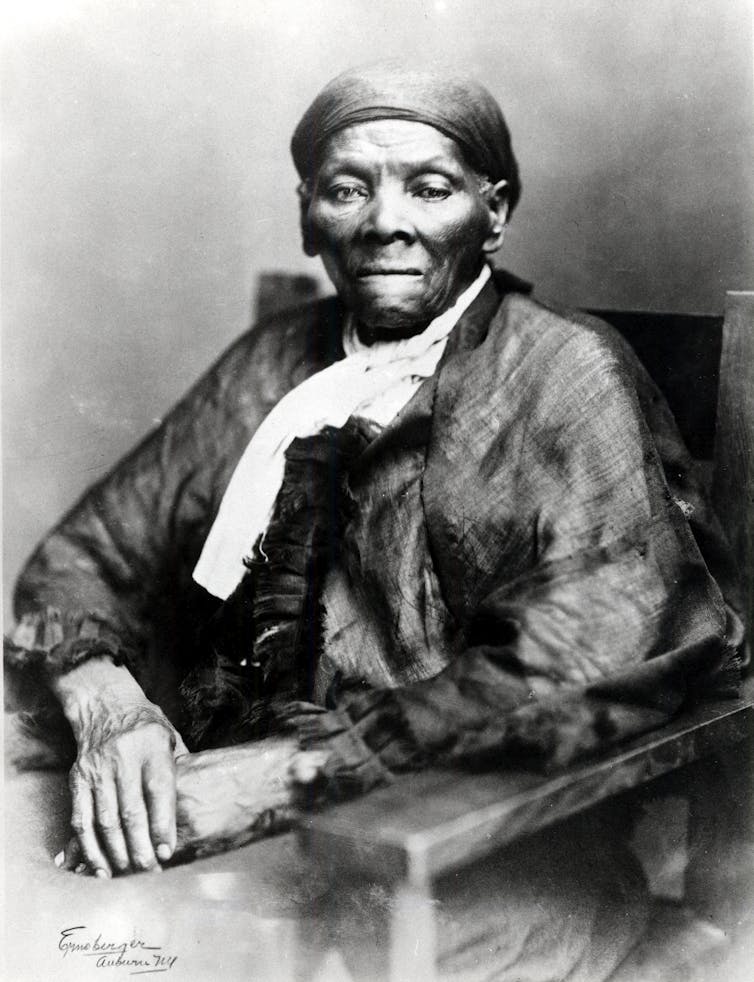
(The Conversation) - Harriet Tubman was barely 5 feet tall and didn’t have a dime to her name.
What she did have was a deep faith and powerful passion for justice that was fueled by a network of Black and white abolitionists determined to end slavery in America.
“I had reasoned this out in my mind,” Tubman once told an interviewer. “There was one of two things I had a right to, liberty, or death. If I could not have one, I would have the other; for no man should take me alive.”
Though Tubman is most famous for her successes along the Underground Railroad, her activities as a Civil War spy are less well known.
As a biographer of Tubman, I think this is a shame. Her devotion to America and its promise of freedom endured despite suffering decades of enslavement and second class citizenship.
It is only in modern times that her life is receiving the renown it deserves, most notably her likeness appearing on a US$20 bill in 2030. The Harriet Tubman $20 bill will replace the current one featuring a portrait of U.S. President Andrew Jackson.
In another recognition, Tubman was accepted in June 2021 to the United States Army Military Intelligence Corps Hall of Fame at Fort Huachuca, Arizona. She is one of 278 members, 17 of whom are women, honored for their special operations leadership and intelligence work.
Though traditional accolades escaped Tubman for most of her life, she did achieve an honor usually reserved for white officers on the Civil War battlefield.
After she led a successful raid of a Confederate outpost in South Carolina that saw 750 Black people rescued from slavery, a white commanding officer fetched a pitcher of water for Tubman as she remained seated at a table.
A different education
Believed to have been born in March 1822 in Dorchester County, Maryland, Tubman was named Araminta by her enslaved parents, Rit and Ben Ross.
“Minty” was the fifth of nine Ross children. She was frequently separated from her family by her white enslaver, Edward Brodess, who started leasing her to white neighbors when she was just 6 years old.
At their hands, she endured physical abuse, harsh labor, poor nutrition and intense loneliness.
As I learned during my research into Tubman’s life, her education did not happen in a traditional classroom, but instead was crafted from the dirt. She learned to read the natural world – forests and fields, rivers and marshes, the clouds and stars.
She learned to walk silently across fields and through the woods at night with no lights to guide her. She foraged for food and learned a botanist’s and chemist’s knowledge of edible and poisonous plants – and those most useful for ingredients in medical treatments.
She could not swim, and that forced her to learn the ways of rivers and streams – their depths, currents and traps.
She studied people, learned their habits, watched their movements – all without being noticed. Most important, she also figured out how to distinguish character. Her survival depended on her ability to remember every detail.
After a brain injury left her with recurring seizures, she was still able to work at jobs often reserved for men. She toiled on the shipping docks and learned the secret communication and transportation networks of Black mariners.
Known as Black Jacks, these men traveled throughout the Chesapeake Bay and the Atlantic seaboard. With them, she studied the night sky and the placement and movement of the constellations.
She used all those skills to navigate on the water and land.
“… and I prayed to God,” she told one friend, “to make me strong and able to fight, and that’s what I’ve always prayed for ever since.”
Tubman was clear on her mission. “I should fight for my liberty,” she told an admirer, “as long as my strength lasted.”
The Moses of the Underground Railroad
In the fall of 1849, when she was about to be sold away from her family and free husband John Tubman, she fled Maryland to freedom in Philadelphia.
Between 1850 and 1860, she returned to the Eastern Shore of Maryland about 13 times and successfully rescued nearly 70 friends and family members, all of whom were enslaved. It was an extraordinary feat given the perils of the 1850 Slave Fugitive Act, which enabled anyone to capture and return any Black man or woman, regardless of legal status, to slavery.
Those leadership qualities and survival skills earned her the nickname “Moses” because of her work on the Underground Railroad, the interracial network of abolitionists who enabled Black people to escape from slavery in the South to freedom in the North and Canada.
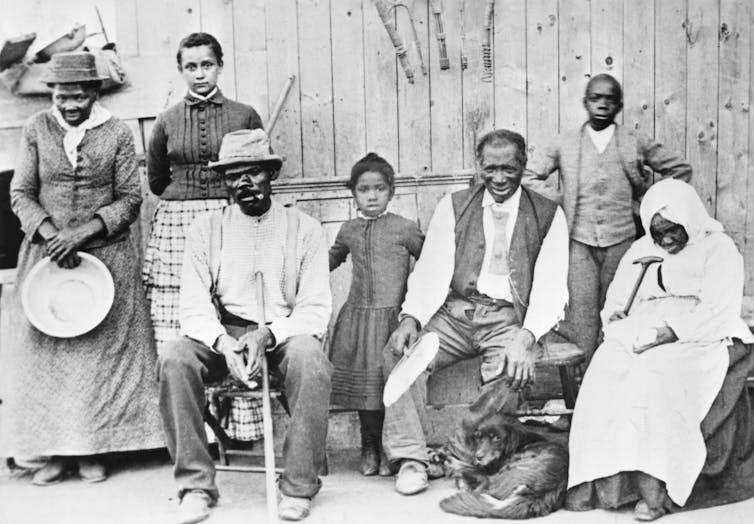
Harriet Tubman, far left, poses with her family, friends and neighbors near her barn in Auburn, N.Y., in the mid- to late 1880s. Bettmann/Getty Images
As a result, she attracted influential abolitionists and politicians who were struck by her courage and resolve – men like William Lloyd Garrison, John Brown and Frederick Douglass. Susan B. Anthony, one of the world’s leading activists for women’s equal rights, also knew of Tubman, as did abolitionist Lucretia Mott and women’s rights activist Amy Post.
“I was the conductor of the Underground Railroad for eight years,” Tubman once said. “and I can say what most conductors can’t say; I never ran my train off the track and I never lost a passenger.”
Battlefield soldier
When the Civil War started in the spring of 1861, Tubman put aside her fight against slavery to conduct combat as a soldier and spy for the United States Army. She offered her services to a powerful politician.
Known for his campaign to form the all-Black 54th and 55th regiments, Massachusetts Gov. John Andrew admired Tubman and thought she would be a great intelligence asset for the Union forces.
He arranged for her to go to Beaufort, South Carolina, to work with Army officers in charge of the recently captured Hilton Head District.
There, she provided nursing care to soldiers and hundreds of newly liberated people who crowded Union camps. Tubman’s skill curing soldiers stricken by a variety of diseases became legendary.
But it was her military service of spying and scouting behind Confederate lines that earned her the highest praise.
She recruited eight men and together they skillfully infiltrated enemy territory. Tubman made contact with local enslaved people who secretly shared their knowledge of Confederate movements and plans.
Wary of white Union soldiers, many local African Americans trusted and respected Tubman.
According to George Garrison, a second lieutenant with the 55th Massachusetts Regiment, Tubman secured “more intelligence from them than anybody else.”
In early June 1863, she became the first woman in U.S. history to command an armed military raid when she guided Col. James Montgomery and his 2nd South Carolina Colored Volunteers Regiment along the Combahee River.
While there, they routed Confederate outposts, destroyed stores of cotton, food and weapons – and liberated over 750 enslaved people.
The Union victory was widely celebrated. Newspapers from Boston to Wisconsin reported on the river assault by Montgomery and his Black regiment, noting Tubman’s important role as the “Black she Moses … who led the raid, and under whose inspiration it was originated and conducted.”
Ten days after the successful attack, radical abolitionist and soldier Francis Jackson Merriam witnessed Maj. Gen. David Hunter, commander of the Hilton Head district, “go and fetch a pitcher of water and stand waiting with it in his hand while a black woman drank, as if he had been one of his own servants.”
When she sought payment for her service as a spy, the U.S. Congress denied her claim. Ity paid the eight Black male scouts, but not her.
Unlike the Union officers who knew her, the congressmen did not believe – they could not imagine – that she had served her country like the men under her command, because she was a woman.
Gen. Rufus Saxton wrote that he bore “witness to the value of her services… She was employed in the Hospitals and as a spy [and] made many a raid inside the enemy’s lines displaying remarkable courage, zeal and fidelity.”
Thirty years later, in 1899, Congress awarded her a pension for her service as a Civil War nurse, but not as a soldier spy.
When she died from pneumonia on March 10, 1913, she was believed to have been 91 years old and had been fighting for gender equality and the right to vote as a free Black woman for more than 50 years after her work during the Civil War.
Surrounded by friends and family, the deeply religious Tubman showed one last sign of leadership, telling them: “I go to prepare a place for you.”
SAN JOSE, Calif. (BCN) -- Incumbent District 4 Santa Clara County Supervisor Susan Ellenberg has spent the last three years championing issues on children, mental health, public safety reforms and economic recovery.
Now she hopes to build on the momentum as she runs for reelection--unopposed. Ellenberg, 55, was first elected in 2019, defeating six other candidates to replace termed-out Supervisor Ken Yeager. She served as board president for the San Jose Unified School District from 2014 to 2018, and also spent six years as a social responsibility and social justice teacher at Yavneh Day School in San Jose.
She said her students inspired her to jump into politics. Her classes examined different socio-economic challenges and racial inequalities in Santa Clara County.
"That was a really eye opening opportunity for me--as well as for my students--to really understand this community a lot more deeply," Ellenberg told San Jose Spotlight. "I have found this career in public service to be extraordinarily rewarding, primarily because I feel useful every day."
As District 4 supervisor, Ellenberg represents more than 400,000 residents in West San Jose, the cities of Campbell and Santa Clara and the unincorporated community of Burbank. She's raised approximately $120,000 for her reelection, campaign filings show.
Championing families, community Ellenberg serves on county committees for public safety and children and families. She's also the chair of the FIRST 5 Santa Clara County Commission and sits on the boards of Joint Venture Silicon Valley and Silicon Valley Clean Energy.
During her first term, Ellenberg worked with other elected officials to bring attention--and potentially solutions--to the mental health and substance abuse crisis in the county.
She pushed for the county to collect community feedback for alternatives to incarceration--work she plans to build on with a year-long workgroup to develop a multi-prong approach on public safety reforms. Ellenberg also spearheaded an effort to reduce unhoused families on the county's streets, developed child care benefits for more than 24,000 county employees and bridged the digital gap for students in her district during the early days of the pandemic.
"I have always focused my policy on children," Ellenberg said.
The supervisor said her priorities for the next term include more programs for child care and more mental health services through investing in the health care workforce and facilities. She also calls for more environmental sustainability policies to protect creeks and plant more trees. Supervisor Otto Lee, who also worked to refocus the county's budget toward mental health and substance abuse programs, said Ellenberg is a true public servant to her constituents.
"She's hard working, determined and always come prepared," Lee told San Jose Spotlight, adding he's not surprised she's running unopposed.
"She's very methodical and very strategic in the way she gets things done." Yeager, Ellenberg's predecessor and a San Jose State University political science professor, said the supervisor has done a good job listening and connecting with her constituents.
"She has a great deal of support in the district," Yeager told San Jose Spotlight, adding incumbent supervisors don't often have challengers.
"She started raising money early and sending out the signal that she was going to fight as hard as she could to win reelection." Walter Wilson, CEO of the Silicon Valley Minority Business Consortium, has also worked closely with Ellenberg on initiatives to reform public safety and jail management in the county.
"People's voices have been muffled over the years about the jail, and she has created a platform so that those voices can be heard," Wilson told San Jose Spotlight. "She's a rock star. Her leadership is the type of leadership we need to bring this valley together."
With a long list of achievements, Ellenberg has secured a hefty roster of support from local leaders and state policymakers, including Lt. Gov. Eleni Kounalakis and Congressmembers Anna Eshoo, Ro Khanna, Adam Schiff and Zoe Lofgren.
She also has the support of all of her colleagues on the Board of Supervisors, as well as all the councilmembers in San Jose, Santa Clara and Campbell.
"Those are all of the areas that I represent," Ellenberg told San Jose Spotlight. "I view that as a stamp of approval for my work and an acknowledgement that I am paying attention to all parts of my district. Nobody is being left behind."
WASHINGTON (AP) — The White House press corps' annual gala returned Saturday night along with the roasting of Washington, the journalists who cover it and the man at the helm: President Joe Biden.
The White House Correspondents’ Association dinner, sidelined by the pandemic in 2020 and 2021, featured Biden as the first president in six years to accept an invitation. Donald Trump shunned the event while in office.
“Just imagine if my predecessor came to this dinner this year,” Biden told an audience of 2,600, among them journalists, government officials and celebrities. “Now that would really have been a real coup.”
The president took the opportunity to test out his comedic chops, making light of the criticism he has faced in his 15 months in office while taking aim at his predecessor, the Republican Party and the members of the press.
“I’m really excited to be here tonight with the only group of Americans with a lower approval rating than I have," Biden said to the Hilton ballroom filled with members of the media.
Biden also made light of the “Let’s Go Brandon” slogan, which has become the right’s stand-in for swearing at the president.
“Republicans seem to support one fella, some guy named Brandon," Biden said, causing an uproar of laughter among the crowd. “He's having a really good year. I'm happy for him."
As far as roasting the GOP, he said, “There’s nothing I can say about the GOP that Kevin McCarthy hasn’t already put on tape.”
He also took a jab at Fox News. “I know there are a lot of questions about whether we should gather here tonight because of COVID. Well, we’re here to show the country that we’re getting through this pandemic. Plus, everyone has to prove they are fully vaccinated and boosted,” Biden said. “Just contact your favorite Fox News reporter. They’re all here. Vaccinated and boosted.”
In addition to speeches from Biden and comedian Trevor Noah, the hourslong event had taped skits from talk-show host James Corden, comedian Bill Eichner and even Biden himself.
“Thank you for having me here,” Noah said to Biden. “And I was a little confused on why me, but then I was told that you get your highest approval ratings when a biracial African guy is standing next to you.”
While the majority of the speech was filled with cutting jabs, Biden did make note of the important role journalism plays in American democracy, especially in the last decade.
“I mean this from the bottom of my heart, that you, the free press, matter more than you ever did in the last century,” he said. “You are the guardians of the truth.”
The dinner had other serious moments, with tributes to pioneer journalists of color, aspiring student reporters as well as a dedication to the journalists detained, injured or killed during the coverage of the ongoing Russian invasion of Ukraine.
The premier event for news media in Washington, the correspondents’ dinner mixed Washington journalists like CNN’s Jake Tapper and MSNBC’s Joy-Ann Reid with celebrities Kim Kardashian, Pete Davidson, Brooke Shields, Caitlyn Jenner, Drew Barrymore and Martha Stewart. Among the large swath of government officials and other prominent figures was Secretary of State Antony Blinken.
Accompanied by the first lady, the president came to the event while trying to strike a careful balance with the nation fatigued by the pandemic yet facing an uptick in infections. The ongoing national threat has struck closer to home for the president: Vice President Kamala Harris tested positive this past week and Dr. Anthony Fauci skipped the dinner for health precautions.
The U.S. was experiencing a COVID-19 case spike from a highly contagious subvariant of omicron, with confirmed infections rising to about 44,000 per day, up from 26,000 a month ago. Still, virus deaths and hospitalizations were near, or at, pandemic lows, with the BA.2 variant proving less severe than earlier virus strains.
In the wake of the recent Gridiron Club press dinner in Washington, dozens of attendees, including members of Congress and of Biden’s Cabinet and journalists, tested positive for COVID-19. The White House Correspondents’ Association said it was requiring same-day antigen testing for its dinner attendees even before the Gridiron outbreak, then added a vaccination requirement.
Biden, 79, decided to pass up the meal but turn up later for the program. While he planned to be masked when not speaking, a maskless president greeted award winners on the dais and could be seen smiling broadly during the dinner program.
The correspondents’ dinner debuted in 1921. Three years later, Calvin Coolidge became the first president to attend and all have since, except Trump. Jimmy Carter and Richard Nixon opted not to attend every year of their presidencies, however, and Reagan, then recovering from an assassination attempt, missed the 1981 installment — but called in from Camp David.
“The thing I think this shows is the restoration to the health of the relationship,” Harold Holzer, author of the book “The Presidents vs. The Press” and the director of the Roosevelt House Public Policy Institute at Hunter College in New York, said ahead of the dinner. “It’s still barbed, there are still tense moments. But that’s OK.”
LEXINGTON COUNTY, S.C. (WSPA) - A former deputy was arrested Friday in Lexington County.
According to the South Carolina Law Enforcement Division, agents charged former Richland County Sheriff's Deputy James Christopher Leaisure, 28, with stalking.
The Lexington County Sheriff's Office requested SLED to investigate Leaisure.
The arrest warrant said Leaisure sent numerous text messages to his spouse which caused fear of assault, death and damage to property.
On April 20, Leaisure sent threatening messages of assault according to the warrant. The next day he sent messages throughout the day describing how he would damage a vehicle so it would not be drivable.
The recipient of the messages fled out of fear for their safety, the arrest warrant said.
On April 22, Leaisure sent many messages in reference to assault that the receiver interpreted as life-threatening.
SLED said a voluntary interview was conducted on April 28 with Leaisure where he confirmed he wrote the messages.
Leaisure was told not to contact his spouse any further during the investigation, but he continued to contact his spouse the following day, the arrest warrant said.
Leaisure was booked in to the Lexington County Detention Center.